Labour Policy
Created 5 Sep 2026
This is the Software Stewardship Lab's Labour Policy, which sets out rules to help us ensure our work is done in an ethically and epistemically responsible way.
Definitions
- Members: The Lab's directors, researchers, advisers and other affiliated staff.
Representation in decision-making
We acknowledge that people of different backgrounds often have situated knowledge about topics they have encountered in their particular lived experiences.
We also acknowledge that, when people face systematic discrimination based on characteristics such as gender, and when this discrimination follows them through different spheres of society, this puts them at an unethical and unfair deficit of power and agency.
This gives us both an epistemic and an ethical reason to aim for the Lab to be governed by a diverse group of decision-makers.
Our policies:
- We aim for 50% of our board to be non-male. Our directors must take this aim into account in any decisions that affect the composition of our board.
Empowerment in decision-making
We acknowledge that representation is meaningless if people are systematically disempowered from sharing their knowledge and making decisions.
One example is epistemic injustice, which occurs when someone is wronged in their capacity as a knower, usually when others incorrectly underestimate their credibility based on characteristics such as gender. These kinds of faulty evaluations are unethical and harm the victim, and are also epistemically problematic because they lead to incorrect judgements.
This kind of behaviour also harms people who bear privileged characteristics. If a speaker is given an excess of credibility because of, say, their gender, this also deprives the speaker of feedback and critique which might help them advance their knowledge.
Speakers may also put themselves at a credibility deficit because of internalised self-prejudice, for example when someone might incorrectly decide that, because they are part of a less privileged group, their knowledge is probably defective and not worth expressing.
Our policies:
- Our members must strive to identify and openly discuss instances of systematic disempowerment, epistemic injustice, and prejudice.
- Victims or witnesses of such behaviour can report it to our board using the information provided in the Contact section.
Good work
We acknowledge that Members might, at different points of their lives, need to be away from their work, for a variety of reasons, including parenting duties, care duties, physical health and mental health.
Our policies:
- As our team works remotely, our Members can do their work from any location that they prefer.
- Our Members have full control over their time and are not expected to adhere to any working hours.
- We aim to be maximally flexible with work allocations, so that unavailable Members can delegate their work to those who are available.
- Members that are unavailable must inform their colleagues of this in a timely manner, but are not required to explain the grounds for their absence.
Addressing gender dimensions in research
We acknowledge that some of the Lab's research topics, such as maintainer burnout and mental health, might be best explained and analysed by incorporating gender as a relevant dimension of explanation.
Our policies:
- Our researchers will either address gender dimensions for topics where gender is relevant, or be prepared to explain why gender is irrelevant to a particular research topic.
Sexual harassment
The Lab has a culture of zero tolerance of sexual harassment.
Our policies:
- We encourage any victims or witnesses of sexual harassment occurring either amongst Members or in affiliated public forums (eg Discord) to report such behaviour using the details provided in the Contact section.
- Our board will investigate all such reports.
Training
Our policies:
- We recommend that Members undergo training for topics such as epistemic injustice and unconscious bias, at their own discretion, if they become aware of potentially beneficial opportunities for such education.
Community consultation
This document is a work in progress. Suggestions are welcome, and can be provided using the details in the Contact section. We also welcome open discussion about these topics in our affiliated public forums (eg Discord).
Contact
Our board can be reached at team@stewardshiplab.org. Those who would like to reach a subset of our board, for example for complaints which involve one of our board members, can contact individual board members using the contact details provided on each of their websites, reachable from the Team section of stewardshiplab.org.
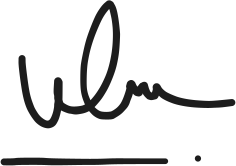 Vlad-Stefan Harbuz, Executive Director
Appendix A: Gender Equality Data
On 18 Jun 2026, the gender breakdown of the Lab's members was:
| Male | Female | Non-binary | |
|---|---|---|---|
| Director | 66.6% | 33.3% | 0.0% |
| Adviser | 100% | 0.0% | 0.0% |